South Africa is home to six Vulture species: the African White-backed Vulture, the Cape Vulture, the Lappet-faced Vulture, the White-headed Vulture, the Hooded Vulture, and the Bearded Vulture. All six are listed as Vulnerable, Endangered, or Critically Endangered on the IUCN Red List.
Each species occupies a different feeding niche at the same carcass. The Lappet-faced Vulture's large, powerful bill allows it to open tough hide that other species cannot break into. The African White-backed Vulture feeds in large, competitive groups once a carcass is accessible. The Hooded Vulture feeds on the periphery, taking scraps once larger species have finished. The Bearded Vulture feeds almost exclusively on bone, a diet no other species shares.
South Africa's six Vulture species at a glance
Bearded Vulture status reflects Southern Africa. Globally, the species is listed as Near Threatened.
Why Vultures matter to South Africa's ecosystems
A carcass left in the open poses a health hazard. Left to decompose naturally, it can take weeks to break down, during which anthrax, botulism, rabies, and brucellosis can build up in the surrounding soil and water. Vultures reduce this risk substantially. A group of Vultures feeding communally, known as a kettle when in flight, can strip a carcass to bone within hours, removing the associated pathogen risk before it reaches wildlife, livestock, or nearby communities. This is explored further in Nature's Clean-Up Crew.
This service is particularly significant in KwaZulu-Natal. The province is a mosaic of protected areas, communal grazing land, commercial agriculture, and rural villages, and a large proportion of the population depends directly on the land for food and water security. Vulture population decline in this context carries consequences for public health and rural livelihoods, not only for biodiversity.
The scale of these consequences has been documented elsewhere. Following the collapse of Vulture populations across South Asia, feral dog populations increased significantly, and the resulting rise in rabies transmission is estimated to have cost the Indian economy approximately USD 34 billion between 1993 and 2006, with around 50,000 additional human deaths linked to the outbreak. Similar patterns are beginning to emerge in parts of southern Africa.
The growing threats facing South Africa's Vultures
Poisoning is one of the most significant threats facing South Africa's Vultures, a crisis explored in Vulture Poisoning in South Africa. Because Vultures feed communally, a single laced or contaminated carcass can kill in excess of 50 birds in one event.
In northern KwaZulu-Natal, poisoning has contributed to an estimated decline of 70 to 80% in Vulture breeding pairs since 2004, with the northern breeding cluster recording losses of up to 81% since 2012. A significant proportion of these poisoning events are intentional, linked to the harvesting of Vulture parts for the traditional medicine trade or to predator control targeting jackals, leopards, and hyaenas. See Why Are Vultures Endangered in Southern Africa? for a fuller account.
Additional threats include collisions with and electrocutions from energy infrastructure, the loss of mature nesting trees, and disturbance at cliff nesting sites. Lead contamination is also widespread: more than a third of sampled African White-backed Vultures in KwaZulu-Natal show elevated blood lead levels.
Not only do these threats have devastating consequences, the species' recovery following such events is severely impacted by the naturally slow breeding processes of Vultures. Vultures mature late, live long, and raise very few young across a lifetime, so a single poisoning event can set a local breeding cluster back by decades. Protecting adult survival is therefore a central priority of South Africa's national Biodiversity Management Plan for Vultures, gazetted in 2024.
The six Vulture species of South Africa
African White-backed Vulture (Gyps africanus)
Zulu name: iNqe Elimhlophe Emhlane Afrikaans: Witrugaasvoël IUCN Red List Status: Critically Endangered Estimated breeding pairs in South Africa: 4,000
.jpeg)
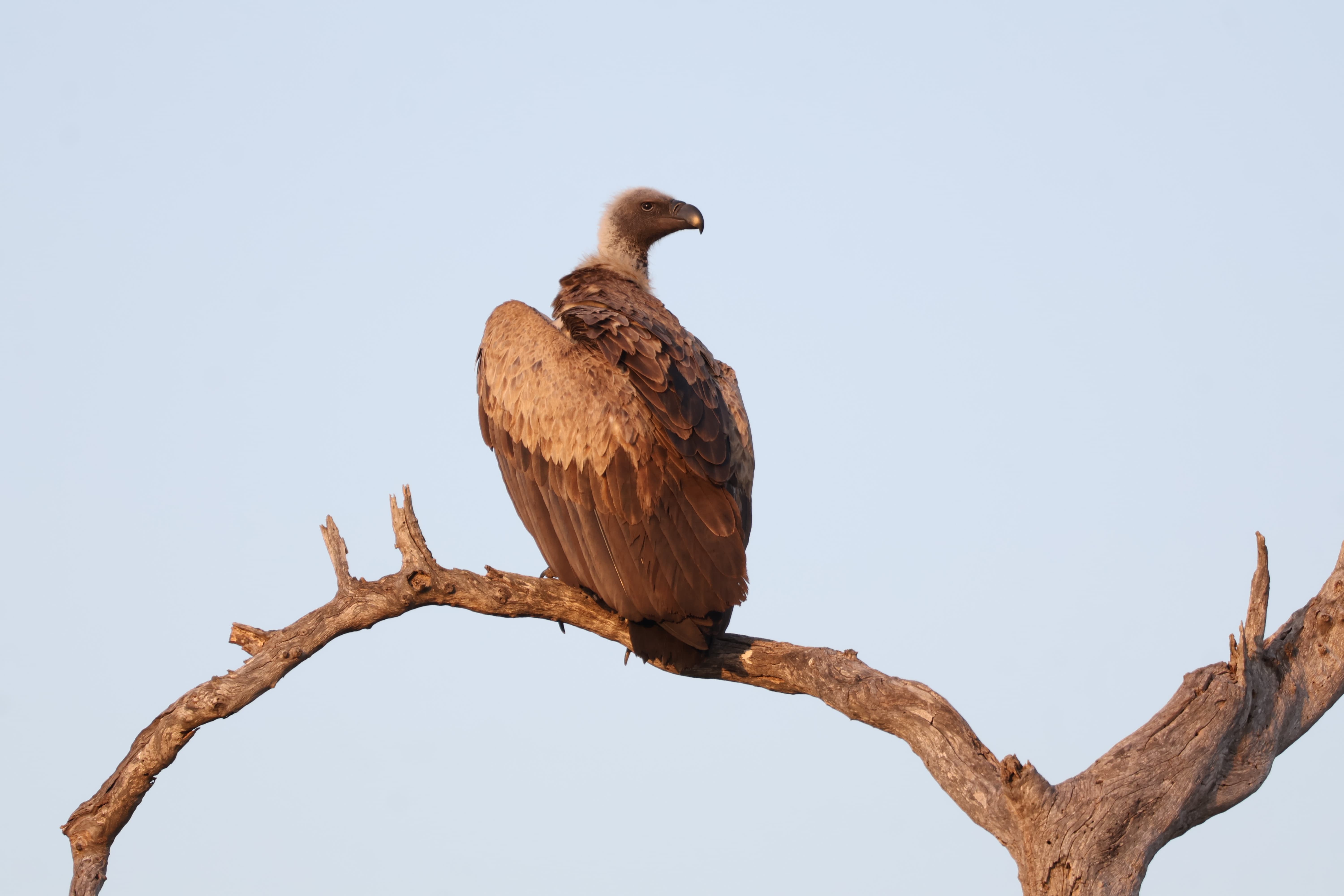
An African White-backed Vulture perched on a dead tree. Photo: Megan Whittington.
The African White-backed Vulture is the most numerous of South Africa's six Vulture species and typically arrives at a carcass in large, competitive groups. It is a medium-to-large bird, standing 90 to 98 cm tall and weighing 4.4 to 7 kg, with a wingspan of approximately 2.1 metres, identified by a white patch on the lower back set against brown plumage and a pale, bald head.
The species locates carcasses by soaring on thermals for extended periods. GPS tracking by Wildlife ACT has recorded individuals ranging across a home range of 70,000 to 107,000 km², travelling as far as 530 km from the nest, reaching altitudes above 1,600 m, and reaching speeds of up to 106 km/h. Northern Zululand marks the southernmost edge of the species' breeding range on the continent, and Hluhluwe-iMfolozi Park holds the largest breeding population in KwaZulu-Natal.
Pairs are monogamous and nest in loose tree colonies, laying a single egg that hatches after approximately 58 days, with both parents caring for the chick for up to six months. The species was listed as Vulnerable as recently as 2000 and was uplisted to Critically Endangered in 2015, reflecting a projected 90% population reduction over three generations if current trends continue.
In April 2026, Wildlife ACT and Ezemvelo KZN Wildlife fitted 19 GPS tracking units to resident birds in Hluhluwe-iMfolozi Park, the largest single tracking deployment for the species in the province's history, detailed in this field report.
Cape Vulture (Gyps coprotheres)
Zulu name: iNqe Yasekoloni Afrikaans: Kransaasvoël IUCN Red List Status: Vulnerable Estimated breeding pairs in southern Africa: 4,500
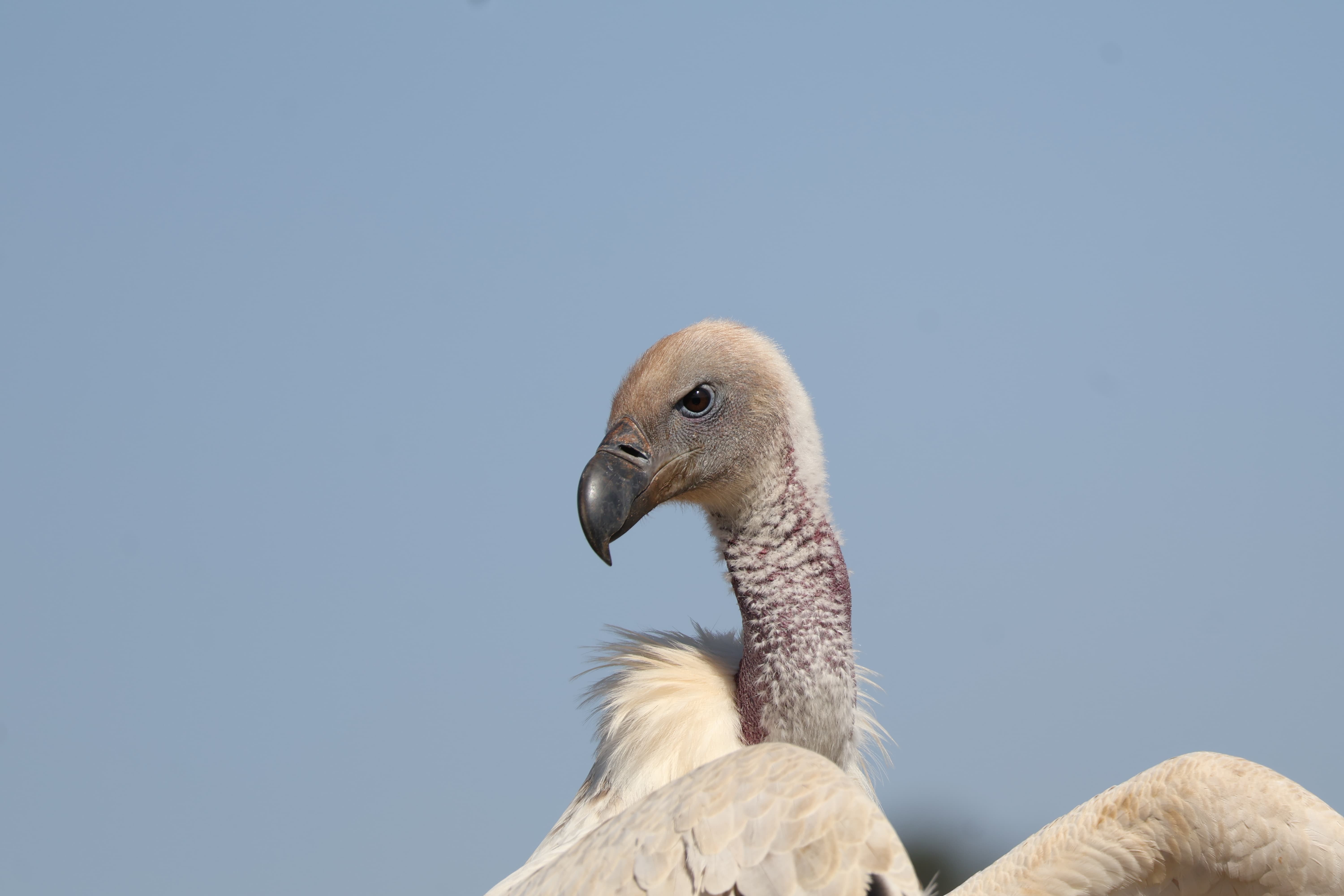
A Cape Vulture, southern Africa's only endemic Vulture species. Photo: Megan Whittington.
The Cape Vulture is southern Africa's only endemic Vulture species, found nowhere else in the world. It formerly bred in Eswatini, Zimbabwe, and Namibia, but is now extinct as a breeding species in Eswatini, with only small, non-breeding populations remaining in the other two countries.
It is also the heaviest Vulture species in South Africa, standing 100 to 110 cm tall and weighing 7 to 11 kg, with a wingspan of up to 2.6 metres. It is distinguished by a bare, blue-toned neck, pale yellow eyes, and cream-coloured plumage.
Cape Vultures nest on cliffs, in colonies that can hold hundreds of pairs along the Great Escarpment and the Maloti-Drakensberg. Approximately 20% of the global population, an estimated 900 to 1,450 breeding pairs, resides within this single mountain system, making the Southern Drakensberg one of the species' most significant strongholds. Pairs are monogamous, often maintaining a lifelong pair bond, and lay one egg per season with an incubation period of approximately 55 days. A Cape Vulture can live for more than 30 years in the wild.
The species carries the least severe global status of South Africa's six Vultures but remains subject to the same core pressures as the rest: poisoning, power line collisions and electrocution, disturbance at breeding cliffs, and a reproductive rate too slow to offset current losses.
Lappet-faced Vulture (Torgos tracheliotos)
Zulu name: iNqe Afrikaans: Swartaasvoël IUCN Red List Status: Critically Endangered Estimated breeding pairs in South Africa: 180, of which only 2 to 6 active nests remain in KwaZulu-Natal
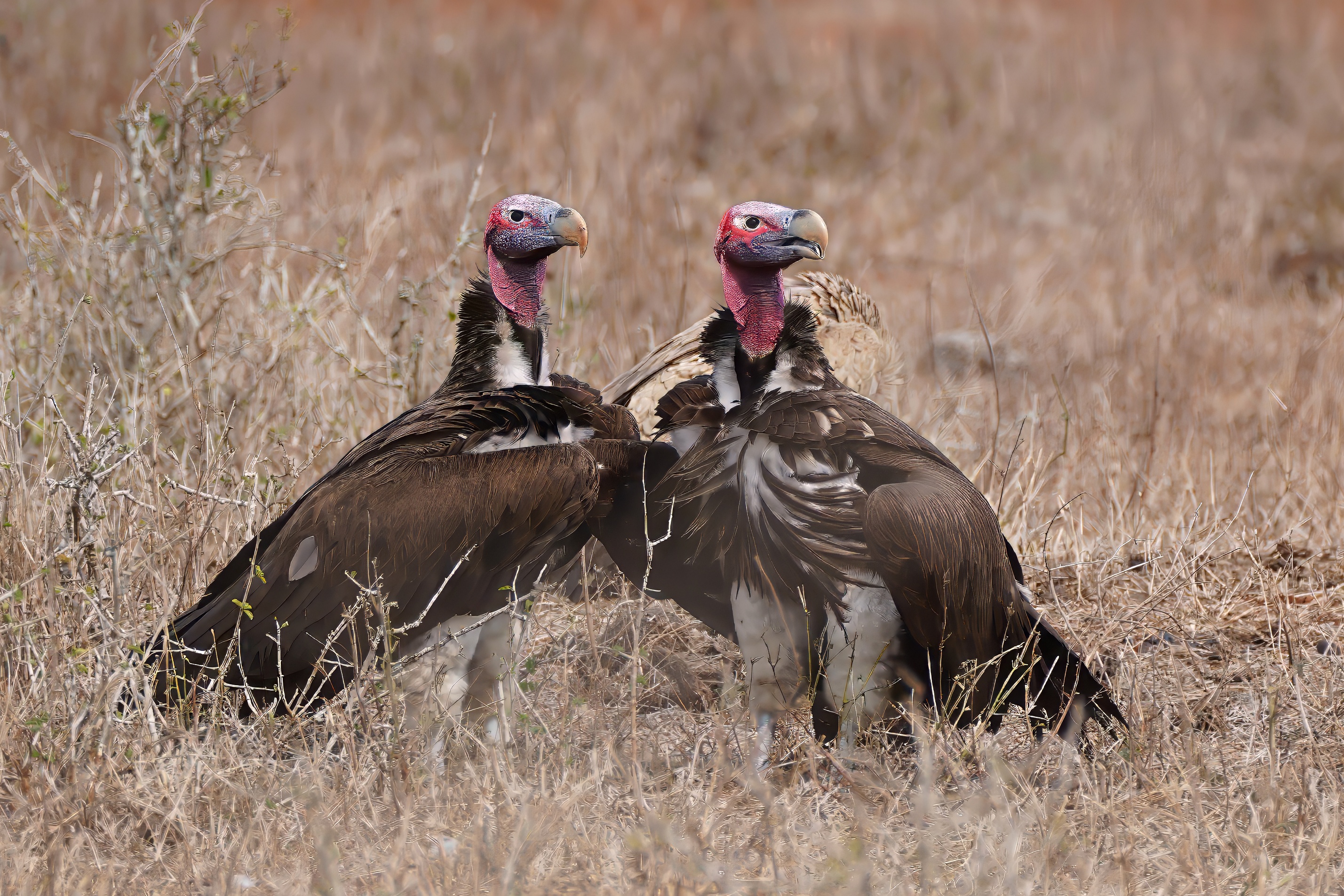
Two Lappet-faced Vultures in the Southern Drakensberg. Photo: Brandie Wettstein.
The Lappet-faced Vulture, often referred to as "the opener," is equipped with a large and powerful bill that is ideal for breaking through the thick hide of a fresh carcass. This species is an aggressive and domineering feeder, with smaller Vulture species typically yielding to it at a carcass.
At up to 8.5 kg and 115 cm tall, with a wingspan of 2.5 to 2.9 metres, it is the largest and most powerful Vulture species in South Africa. It is distinguished by a bald, reddish-pink head and prominent facial skin folds.
The species is typically seen alone or in pairs rather than in the large groups formed by the African White-backed Vulture. GPS tracking has recorded individuals ranging across a home range of 30,000 to 90,000 km², travelling up to 494 km from the nest and reaching altitudes of nearly 1,200 m. Pairs do not reach breeding maturity until approximately six years of age, and raise a single chick per year, with chick dependency lasting five to six months.
In KwaZulu-Natal, active nests have declined from approximately 15 in 2020 to between two and six in recent years. Without targeted intervention, the species faces local extinction in the province. A provincial aerial survey in August 2025, covered in the Zululand Aerial Survey results, confirmed four active nests in Hluhluwe-iMfolozi Park, and in early 2026 a helicopter-supported operation, the first of its kind in the province, was used to fit GPS tracking units to Lappet-faced Vulture chicks, as reported in this update.
White-headed Vulture (Trigonoceps occipitalis)
Zulu name: iNqe Emakhanda Elimhlophe Afrikaans: Witkopaasvoël IUCN Red List Status: Critically Endangered Estimated breeding pairs in South Africa: 80 to 100
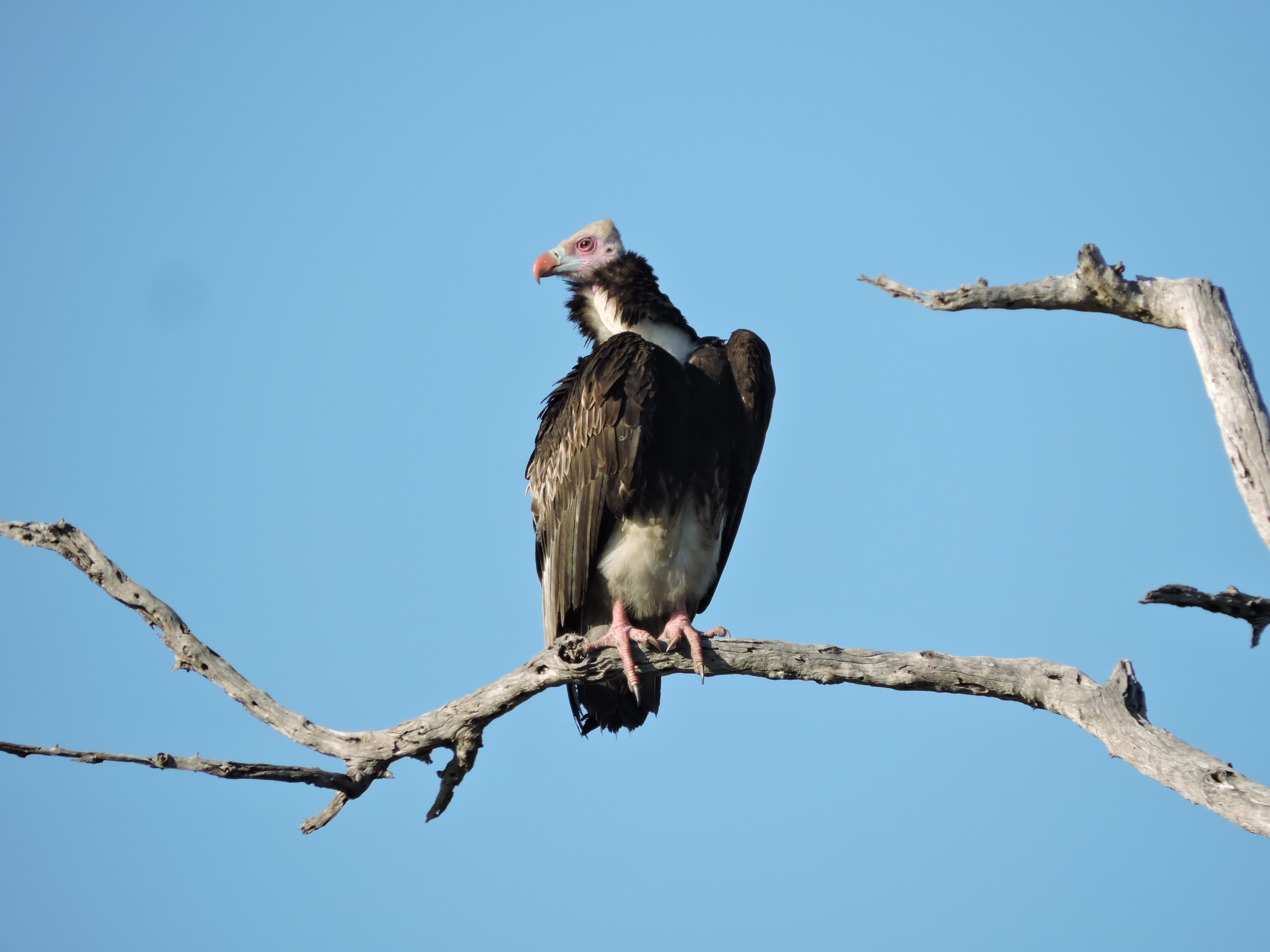
A White-headed Vulture, identifiable by its pale head and orange-and-black bill. Photo: Megan Whittington.
The White-headed Vulture has an unusually low annual breeding rate. Approximately 61% of pairs do not breed in a given year because they are still caring for a dependent chick from the previous season, a pattern that leaves the species highly vulnerable to adult mortality.
It is a stocky, medium-sized bird, standing 78 to 82 cm tall and weighing 3.3 to 5.3 kg, with a wingspan of around 2 metres. It is distinguished by a bright orange-and-black bill and a pale, triangular head, and typically flies lower than other species, often arriving first at a carcass. It nests alone or in monogamous pairs, most commonly in Acacia trees.
The species was listed as Vulnerable in 2000 and uplisted to Critically Endangered in 2015. In 2021, following nest surveys conducted by Ezemvelo KZN Wildlife and Wildlife ACT, the White-headed Vulture was confirmed regionally extinct as a breeding species in KwaZulu-Natal. No active nest has been recorded in the province since 2017, representing the loss of a breeding species from the province's ecological network within a single decade.
Hooded Vulture (Necrosyrtes monachus)
Afrikaans: Monnikaasvoël IUCN Red List Status: Critically Endangered Estimated breeding pairs in South Africa: 50 to 100
-2.jpeg)
Hooded Vultures at uMkhuze. Photo: Megan Hudson.
The Hooded Vulture is the smallest of South Africa's six Vulture species, weighing 1.5 to 2.6 kg with a wingspan of around 160 cm. It is distinguished by a dark hood of feathers and a pale, featherless face. Its small size allows it to rise on thermals more easily than larger species, which often makes it among the first to arrive at a carcass. It typically feeds on the periphery, taking scraps once larger species have fed.
The species is the most habitat-flexible of the six, found in open grassland, savanna, forest edge, coastal areas, and around human settlements. Pairs are monogamous, laying a single egg with an incubation period of 48 to 54 days, and chicks remain dependent for approximately seven months.
In September 2025, the first active Hooded Vulture nest recorded in KwaZulu-Natal was confirmed on private land in northern Zululand, a milestone covered in A Conservation Milestone for KwaZulu-Natal. This is also the southernmost breeding record for the species documented anywhere in the world.
Bearded Vulture (Gypaetus barbatus)
Common names: Bearded Vulture, Lammergeier, Ossifrage Zulu name: uKhozilwentshebe Afrikaans: Baardaasvoël IUCN Regional Status: Regionally Critically Endangered Estimated breeding pairs in South Africa and Lesotho: 50 to 100
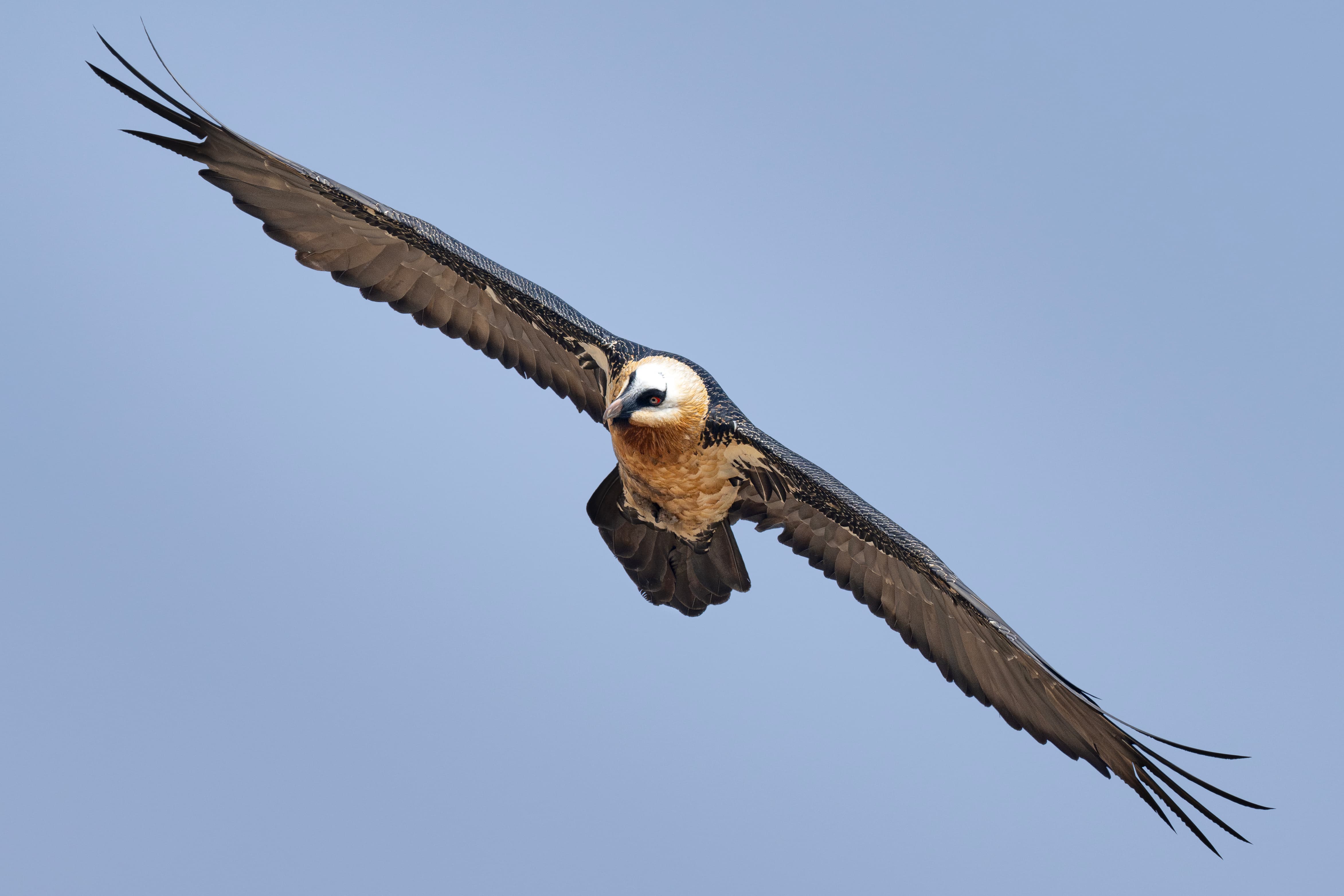
A Bearded Vulture in flight, showing its distinctive diamond-shaped tail. Photo: Manfred Suter.
What makes the Bearded Vulture unique among Vulture species is that its primary diet preference is for bone. In fact, it feeds on bone almost exclusively, at up to 90% of dietary intake, and is the only known vertebrate on the planet that does this. Its stomach acid, at close to pH 1, is able to dissolve bone fragments that no other scavenger can digest. When a bone is too large to swallow, the bird carries it into the air and drops it onto a rocky surface known as an ossuary to break it open, a technique that young birds take several years to learn.
Adults weigh approximately 6 kg and have a wingspan of 2.6 metres. The species is identified in flight by a long, diamond-shaped tail found on no other South African Vulture species. Unlike its five relatives, the Bearded Vulture does not have a bald head; a fully feathered head and neck is an adaptation to its high-altitude mountain habitat. Its rust-orange plumage, acquired through bathing in mineral-rich water, together with red-ringed eyes, has earned it the name "Monarch of the Mountains."
Globally, the species is listed as Near Threatened, with stable populations across Europe, Asia, and parts of eastern Africa. Its entire Southern Hemisphere population, however, is confined to the Maloti-Drakensberg range of South Africa and Lesotho and is genetically distinct from all other populations. For this reason, it is classified as Regionally Critically Endangered in Southern Africa.
Bearded Vultures nest on remote cliff ledges, laying one or two eggs between May and November, though typically only one chick fledges. That chick remains dependent on its parents for up to two years. Breeding territory has declined by 27% or more in recent decades, and with only 50 to 100 breeding pairs remaining across South Africa and Lesotho, the loss of even a small number of breeding adults would have a significant impact on the population.
How Wildlife ACT is protecting South Africa's Vultures
Wildlife ACT's Vulture Conservation Programme addresses these threats through direct field monitoring and rapid response. Field teams operating through the Zululand Vulture Project and Project Vulture KZN track breeding activity across KwaZulu-Natal's protected areas and respond to poisoning incidents as they occur, work supported by GPS tracking technology deployed through Wildlife ACT Innovations.
This monitoring extends into the Southern Drakensberg, where the Mzimkulu Vulture Hide provides Cape Vultures and Bearded Vultures with a safe, uncontaminated feeding site. The hide also allows visitors and volunteers to observe the birds at close range, combining conservation with public engagement.
Wildlife ACT's contribution extends beyond field operations into national policy. Co-Founder Chris Kelly took part in drafting South Africa's Biodiversity Management Plan for Vultures, gazetted in 2024, and the organisation continues to work alongside Ezemvelo KZN Wildlife, the Endangered Wildlife Trust, and the Bearded Vulture Task Force to coordinate monitoring, emergency response, and long-term recovery planning across the province.
Ways to support South Africa's Vultures
Vulture conservation in South Africa depends on sustained monitoring, rapid poisoning response, and ongoing field support, and this work can be supported in several ways.
Donate towards Wildlife ACT's Vulture Conservation Programme. Support for the programme directly through Wildlife ACT's donation page. Funds contribute to emergency poisoning response, nest monitoring, and GPS tracking equipment.
Field volunteering. The Southern Drakensberg Conservation Program, based in the Maloti-Drakensberg Park, a UNESCO World Heritage Site, places volunteers alongside trained field staff to assist with nest monitoring, safe feeding site maintenance, data analysis, and camera trap checks.
The Mzimkulu Vulture Hide. Located near Underberg in the Southern Drakensberg, this purpose-built hide allows birders and photographers to observe Cape and Bearded Vultures feeding at a safe feeding site, covered in more detail in this update. Bookings can be made through saveourvultures.com, and proceeds fund site maintenance and long-term monitoring.
Citizen science reporting. Members of the public who observe a wing-tagged or colour-ringed Vulture can report the sighting through Project Vulture. These reports contribute directly to the movement tracking and population monitoring data used by conservation teams.
Equipment donations. Field equipment such as camera traps, GPS units, and veterinary supplies can be gifted directly through the Wildlife ACT Wishlist.
Public awareness. Vultures are frequently misrepresented as threatening or unsanitary rather than recognised as providing an essential ecological service. Sharing accurate information about their role supports broader public understanding and conservation efforts.
Frequently asked questions about South Africa's Vultures
How many Vulture species live in South Africa?
South Africa has six resident Vulture species: the African White-backed Vulture, the Cape Vulture, the Lappet-faced Vulture, the White-headed Vulture, the Hooded Vulture, and the Bearded Vulture. All six are listed as Vulnerable, Endangered, or Critically Endangered on the IUCN Red List.
What does "Regionally Critically Endangered" mean for the Bearded Vulture?
The Bearded Vulture is listed as Near Threatened on the global IUCN Red List, reflecting stable populations across Europe, Asia, and parts of eastern Africa. In Southern Africa, however, the entire population is confined to the Maloti-Drakensberg range of South Africa and Lesotho, genetically isolated from every other population on Earth, which is why it carries the separate regional classification of Regionally Critically Endangered here.
What distinguishes a Cape Vulture from an African White-backed Vulture?
The Cape Vulture is larger and heavier, with a bare, blue-toned neck and pale, cream-coloured plumage, and nests on cliffs. The African White-backed Vulture is smaller, brown overall with a distinctive white patch on the lower back, and nests in trees.
Why are Vultures important to the environment and to people?
Vultures remove carcasses from the landscape within hours, neutralising pathogens such as anthrax, botulism, and rabies through their highly acidic digestive systems before these diseases can spread to wildlife, livestock, or people. Vulture population decline elsewhere in the world has been linked to a rise in feral dog populations and rabies transmission, at an estimated cost of USD 34 billion to the Indian economy between 1993 and 2006.
How can I help protect Vultures in South Africa?
Support can be given by donating to Wildlife ACT's Vulture Conservation Programme, volunteering with the Southern Drakensberg Conservation Program, visiting the Mzimkulu Vulture Hide, reporting tagged Vulture sightings through Project Vulture, or contributing equipment through the Wildlife ACT Wishlist.
.jpeg)


.jpg)